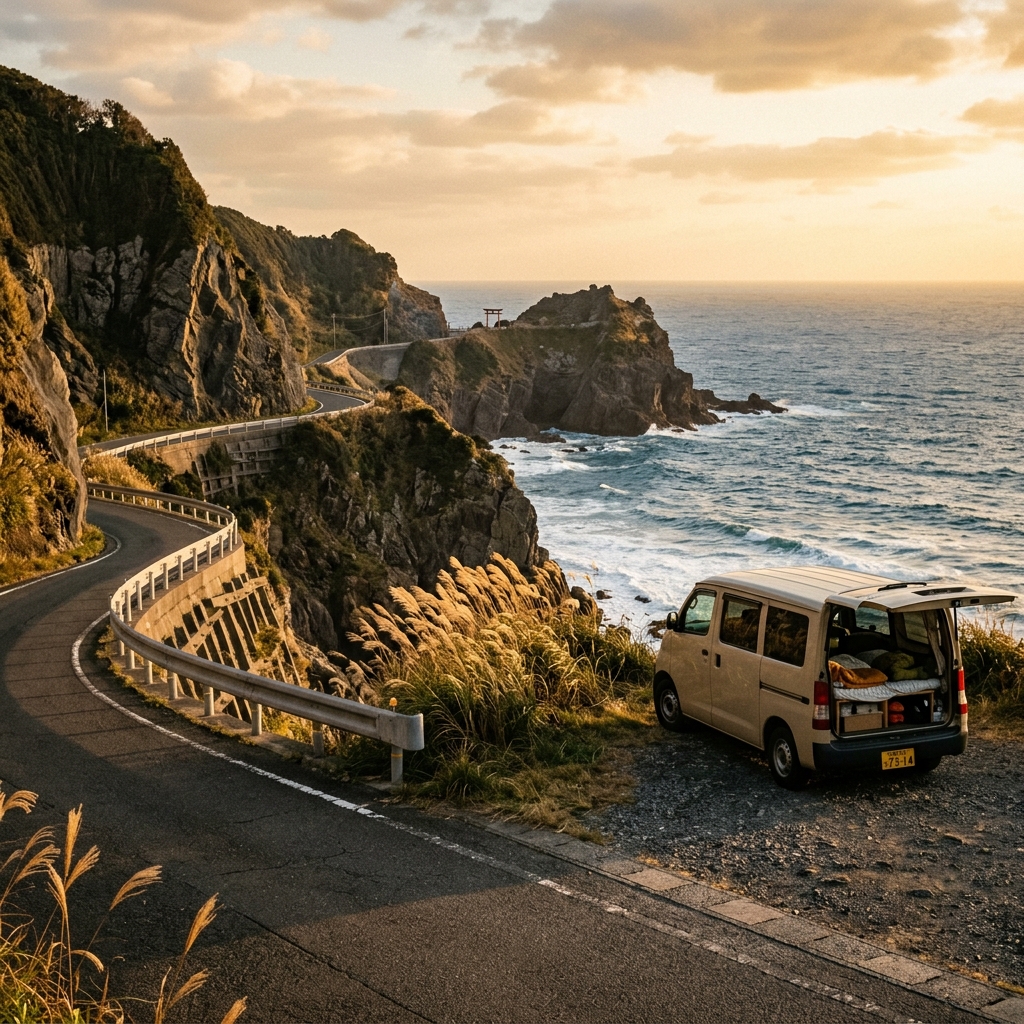
You've seen this genre of travel article before: the one that lists scenic drives with stock-photo enthusiasm and directions cribbed from Google Maps. We've written one ourselves. It's useful. It tells you what to drive.
This is not that article.
This is the one that tells you how. These are the five drives we actually do on our days off: the routes where we know exactly when to leave, which roadside stall has the best mochi, and at precisely which curve you should slow down because the view is about to make you pull over whether you planned to or not. After 35-odd years of living in Kyushu, these roads feel less like routes and more like rituals.
So here they are. Not ranked, not optimized for SEO, not chosen because they photograph well for Instagram. These are the drives we reach for when we need a reset.
1. The Itoshima Sunset Loop (糸島サンセットロード)
Fukuoka's back door to the Genkai Sea
Every city needs an escape valve. For Fukuoka, it's Itoshima. The drive west takes 40 minutes and feels like crossing into a different decade. The coastline from Futamigaura (二見ヶ浦) to Keya (芥屋) is what locals half-jokingly call "our California," and honestly, on a golden afternoon with the windows down and salt air flooding the cabin, the comparison isn't as absurd as it sounds.
Here's the local protocol: leave Fukuoka at 4pm. Not 3pm (too early, you'll run out of things to do before the main event), and definitely not 5pm (you'll hit the sunset in traffic on the Nishi-Kyushu Expressway, which is beautiful but also dangerous). Four o'clock. Take the coastal Route 54 west.
Your first stop is Futamigaura, where two sacred rocks called meoto iwa (夫婦岩) sit in the ocean connected by a shimenawa rope, framed by a white torii gate. During the day, it's pretty. At sunset, when the sky ignites behind those rocks and the gate becomes a silhouette against streaks of copper and violet, it's the kind of scene that makes you understand why Shinto considers certain landscapes divine. Get there by 5:30pm in summer, earlier in winter.
Local tip: The parking lot at Futamigaura fills up on weekends. Park at the Itoshima Surf Shop lot 200 meters east (they don't mind as long as you're respectful) and walk along the beach. Better photos from that angle anyway.
From Futamigaura, continue west along the coast. You'll pass the London Bus Cafe, and yes, it's exactly what it sounds like: a vintage red double-decker bus parked on a cliff above the ocean, serving surprisingly good drip coffee and scones. It's a little kitschy, sure, but sitting on the upper deck with the Genkai Sea stretching to the horizon? That's earned kitsch.
In winter (November through March), the real draw is the kaki goya (牡蠣小屋), ramshackle oyster huts that pop up along the coast like delicious seasonal mushrooms. For about ¥1,000, you get a pile of Itoshima oysters to grill yourself over charcoal. Bring your own drinks and sides. The locals do. The huts provide gloves, tongs, and absolutely no pretension.
End at Keya fishing port, where the pace slows to something geological. If you're traveling by campervan, the port area has informal parking where you can watch the fishermen sort the day's catch as the last light fades. It's not a designated overnight spot, but early morning departures are tolerated. Just be gone by 7am when the market activity picks up.
The road less Instagrammed: On your way back, skip the expressway and take the backroad through Raizan (雷山). Follow the signs to Raizan Sennyoji (雷山千如寺), a 1,300-year-old temple tucked into the mountainside with a 400-year-old maple tree in its courtyard. In autumn, it's spectacular. In any season, the silence is startling. You're 25 minutes from a city of 1.6 million people, and you might be the only visitor.
2. Aso Milk Road at Dawn (阿蘇ミルクロード → 大観峰)
The drive that justifies the alarm clock
I need to be honest with you about this one: it requires a 4:30am departure. I know. But in the taxonomy of Kyushu drives, the Milk Road at dawn occupies a category of its own. It recalibrates your understanding of what a "scenic drive" can be.
The Milk Road (ミルクロード) is a highland route that winds across the northern rim of the Aso caldera, named after the dairy farms that dot the plateau. The road itself is the attraction: gentle S-curves through endless kusasenri grassland, the grass rippling like water in the pre-dawn wind, occasional cows regarding you with bovine indifference. At that hour there is almost no traffic. It's just you and the road and the slowly brightening sky.
Your destination is Daikanbo (大観峰), the panoramic viewpoint at the northern edge of the caldera. On the right morning (cool temperatures, high humidity, clear skies above) you'll arrive to find the entire Aso valley filled with a sea of clouds (unkai, 雲海). The five peaks of Aso rise through the white like the fingers of a sleeping Buddha, which is, in fact, exactly what locals have always said they resemble. It is, without exaggeration, one of the most extraordinary natural spectacles in Japan.
Honest note: The unkai happens maybe 30% of mornings, mostly between late September and early December. Check the weather conditions the night before. You want a clear sky with ground-level fog, typically after a rainy day. And when it doesn't happen, the sunrise over the caldera is still magnificent. You won't feel cheated. I've driven this road maybe fifty times, and I've never once regretted getting up.
If you're staying in a campervan, the strategy is simple: park overnight at Michi-no-Eki Aso (道の駅阿蘇), a well-maintained rest station with restrooms, vending machines, and a parking area where overnight stays are accepted. From there, Daikanbo is a 20-minute drive up the mountain. Set your alarm, make coffee in the van, and go. You'll be at the viewpoint before most people's alarms have even gone off.
After the sunrise spectacle, descend and wait for 9am, when the roadside dairy shops along the Milk Road open their shutters. The soft-serve ice cream here is made from milk that was, very likely, inside a cow about twelve hours ago. It tastes like what soft-serve wishes it tasted like everywhere else. Rich, grassy, slightly sweet. ¥350 for a cone that might ruin all other ice cream for you.
From here, you have options. Continue east to Kuju Flower Park (くじゅう花公園) for an absurdly picturesque stroll through highland meadows. Or detour south to Waita Onsen (わいた温泉), a collection of rustic hot springs where you can soak in an outdoor rotenburo with steam rising from the volcanic earth around you. It's the perfect counterpoint to your early-morning adventure. Several of the onsen here offer kashikiri (貸切) private baths for about ¥1,500 per group, which is extraordinarily reasonable for the experience.
3. Kunisaki Peninsula Hidden Loop (国東半島の裏道)
A thousand years of sacred stone, and nobody's here
If I had to choose one drive on this list as the most underrated, Kunisaki wins without contest. This stubby peninsula jutting out from northeastern Oita Prefecture gets skipped by almost everyone. Tourists beeline south to Beppu for hot springs, west to Yufuin for Instagram, and Kunisaki just sits there, quietly holding a thousand years of Buddhist art in its volcanic cliffs, waiting for someone to notice.
The peninsula was once a center of Rokugo Manzan (六郷満山) culture, a syncretic blend of Buddhism, Shinto, and mountain asceticism that flourished here from the 8th century onward. What this means in practical terms: the mountains are riddled with ancient temples, and the cliff faces are carved with enormous stone Buddhas (magaibutsu, 磨崖仏) that have been weathering quietly for a millennium. Kumano Magaibutsu (熊野磨崖仏) is the most famous: two massive Buddha figures carved into a rock face, reached by a steep trail of rough-hewn stone steps through the forest. The climb takes about 20 minutes and will make your calves burn, but standing face-to-face with an 8-meter Dainichi Buddha that someone carved into living rock in the 12th century tends to put physical discomfort in perspective.
Start the loop from Usa, on the western edge of the peninsula, and begin with Usa Jingu (宇佐神宮). This is the head shrine of all 44,000 Hachiman shrines in Japan. The original, the mothership. By rights it should be mobbed. But because it's in Usa (which, delightfully, causes confusion when Japanese people abbreviate "Usa, Japan" to "USA" on their addresses), it receives a fraction of the visitors that lesser shrines in Kyoto attract. Walk the grounds on a weekday morning, and you might have the vermillion corridors entirely to yourself.
Lunch strategy: Skip the tourist restaurants near the shrine. Drive 20 minutes to any of Kunisaki's small fishing ports (Takedazu or Imi are good bets) and find the local shokudō (食堂). Order the kaisen-don (海鮮丼). You'll get a bowl of rice buried under glistening sashimi for ¥1,200 to ¥1,500: local buri, aji, tai, whatever came in that morning. The same bowl in Beppu would cost you ¥2,500. Same fish, too, since it's caught from the same waters.
Continue the loop clockwise through the interior, and you'll pass through Tashibu no Shō (田染荘), rice terraces that have been farmed continuously since the Heian period, over a thousand years of unbroken cultivation. They're a candidate for UNESCO World Heritage status, and when the paddies are flooded in early June, reflecting the sky and surrounding hills, you'll understand why. The composition is so perfect it looks designed, and in a sense it was, shaped by a hundred generations of farmers who understood that beauty and function aren't opposing forces.
For the grand finale, make your way to Fukiji Temple (富貴寺). This 900-year-old wooden hall sits in a grove of ginkgo trees and contains faded but extraordinary Amida Buddha paintings on its interior walls. In autumn, the ginkgo leaves carpet the ground in gold around the dark, austere hall. If you arrive in a campervan near sunset, park in the small lot below the temple. On a quiet evening, you may have the entire complex (building, trees, silence) completely to yourself. That's not hyperbole. It's Tuesday in Kunisaki.
4. Nichinan Coast to Obi Castle Town (日南海岸 → 飫肥の城下町)
Where Kyushu goes tropical
Miyazaki Prefecture is Kyushu's warm, easygoing south. Mainland Japanese associate it with palm trees, surfing, and a certain laid-back energy that feels more Okinawan than Kyushu. The Nichinan Coast drive along Route 220 is where that character is most vivid: blue water, black volcanic rock, palm-lined roads, and a climate warm enough that you half-expect to see a toucan.
Start at Aoshima (青島), a tiny island connected to the mainland by a walkway, surrounded by the famous "Devil's Washboard" (oni no sentakuita, 鬼の洗濯板): wave-cut rock platforms that extend from the shore in concentric ridges, looking exactly like a washboard scaled up for a demon's laundry day. The geology is fascinating, with alternating layers of sandstone and mudstone eroded at different rates over millions of years, but even if geology isn't your thing, the visual impact is striking. A small, intensely tropical shrine sits at the island's center, wreathed in betel palms and subtropical plants.
From Aoshima, Route 220 winds south along the coast. This stretch is studded with pull-off areas that make ideal lunch spots if you're traveling in a campervan. Many are free, and most have ocean views. Slide open the side door, set up your table facing the Pacific, and take your time. Nobody's rushing you. This is Miyazaki. Nobody rushes.
About 40 minutes south, you'll reach Udo Jingu (鵜戸神宮), and this is where the drive shifts from pretty to profound. Udo Jingu is a Shinto shrine built inside a cave in the cliffside, overlooking the ocean. You descend a stone staircase along the cliff face to reach it, the Pacific crashing on the rocks below, and then step into this vermillion-painted cave shrine dedicated to fertility and safe childbirth. There's a tradition of throwing undama (運玉), small clay balls, and trying to land them in a hollow on a turtle-shaped rock below. Men throw with the left hand, women with the right. It's harder than it looks, and the sound of clay pinging off rock and tourists groaning in comic frustration is part of the charm.
Timing tip: Visit Udo Jingu in the morning when the sun illuminates the cave entrance. By afternoon the cliff casts shadow and the photos aren't quite the same. Neither is the atmosphere.
After the coast, head inland to Obi (飫肥), and prepare for a tonal shift. Obi is a beautifully preserved castle town, sometimes called "the little Kyoto of Kyushu," though that undersells its distinct personality. The streets are lined with whitewashed walls and stone channels where actual carp swim. You'll see flashes of orange and white in the water running alongside the sidewalk. It's surreal and somehow completely natural at the same time.
The essential Obi experience is obi-ten (飫肥天), a local specialty: fish cake made with tofu and brown sugar, deep-fried to a golden crisp. It sounds odd. It's extraordinary: slightly sweet, savory, with a texture that's lighter than regular tempura. Buy one from any of the small shops on the main street for about ¥150 and eat it walking. Pair it with Obi's other specialty, atsumeshi (あつめし), sashimi marinated in soy-based sauce served over hot rice, at one of the old-town restaurants. A full meal runs about ¥1,000, and it's the kind of food that makes you wonder why this town isn't more famous.
5. Sotome & the Hidden Christians Coast (外海の隠れキリシタン海岸)
UNESCO World Heritage. Population: almost nobody.
This is the drive that moves people. Not "moves" as in "oh that's nice," but moves as in "I need to sit quietly for a while and think about what I just experienced." The Sotome coast north of Nagasaki city is part of the UNESCO-listed "Hidden Christian Sites in the Nagasaki Region," and despite that heavyweight designation, it remains almost eerily uncrowded. The tour buses go to Glover Garden and the Peace Park. The Sotome coast belongs to the wind and the sea and the small stone churches that stand, improbably, on clifftops overlooking the East China Sea.
The history is essential to understanding what you're seeing. In 1614, Christianity was banned in Japan. For the next 250 years, a quarter of a millennium, communities of secret Christians (kakure kirishitan, 隠れキリシタン) in this region practiced their faith in hiding, passing down prayers in a garbled mix of Portuguese and Japanese, disguising the Virgin Mary as Kannon, the Buddhist goddess of mercy, and meeting in private homes at risk of execution. When the ban was finally lifted in the 1870s, they emerged and built churches. The churches you see today on the Sotome coast are the physical manifestation of that emergence: faith made stone after centuries of silence.
Drive north from Nagasaki city along the coastal road. The route is narrow in places, single-lane with passing spots, and the cliffside drops are dramatic. In a campervan, take it slow and use the mirrors. But the narrowness is part of the experience: this is not a road built for tourism. It's a road built for fishing villages, and it happens to pass through one of the most emotionally charged landscapes in Japan.
Your first major stop is Shitsu Church (出津教会), designed by Father Marc Marie de Rotz, a French priest who arrived in Sotome in 1879 and spent the rest of his life there. De Rotz didn't stop at churches. He built schools, an orphanage, a macaroni factory (yes, really), and various small industries to lift the impoverished community out of poverty. The church itself is modest and white, with thick walls built to withstand typhoons, and an interior that's simple, plain, and somehow all the more powerful for it.
Further along is Ono Church (大野教会), smaller and built partly from local stone in a style that blends European ecclesiastical architecture with Japanese farm building techniques. It sits on a hillside surrounded by fields, and if you visit on a quiet weekday, the only sounds will be birdsong and the distant sea. These aren't grand cathedrals. They're humble buildings built by humble people who waited two and a half centuries to worship openly. That context gives them a gravity that no amount of architectural grandeur could match.
Essential stop: The Endō Shūsaku Literary Museum (遠藤周作文学館) sits on a cliff overlooking the sea near Sotome. Endō's novel Silence, later adapted into a film by Martin Scorsese, was set in this region and explores the persecution of Christians with devastating empathy. The museum is small but carefully put together, and the view from its terrace is worth the drive on its own: the same sea that Endō's characters gazed upon in despair and hope. Admission is ¥360.
For food, stop at any of the tiny restaurants in the fishing villages along the route. These aren't places with English menus or tourist pricing. Point at what looks good, say "osusume wa?" (おすすめは?), which means "what do you recommend?", and trust the answer. Fresh sashimi, grilled fish, maybe a bowl of simple miso soup with clams pulled from the water that morning. ¥800 to ¥1,200 for a meal that a Nagasaki city restaurant would charge twice for.
If you're in a campervan, the stretch between Shitsu and Ono has a few informal pull-off areas where you can park and simply look at the sea. The East China Sea sunsets from this coast are remarkable. The horizon is unbroken, the light turns the water to hammered bronze, and the silhouettes of the Gotō Islands appear in the distant haze like a promise of more hidden churches, more untold stories. (They are. The Gotō Islands are extraordinary. But that's another article.)
The drives we keep coming back to
A good drive needs more than scenery. It needs rhythm: knowing when to leave, where to stop, when to linger, and when to let the road unspool ahead of you in comfortable silence. These five drives have that rhythm because they've been worn smooth by repetition, by locals returning to them season after season, finding something slightly different each time.
Itoshima at sunset, Aso at dawn, Kunisaki in its ancient quiet, the Nichinan coast in its tropical ease, Sotome in its solemn beauty. These aren't the drives you'll find in a guidebook. They're the ones we reach for when we need to remember why we love living here.
And now they're yours too.
Drive them slowly. Stop often. Talk to the person behind the counter. Buy the thing that looks weird. Take the backroad. And if you find yourself pulling over just because the light is doing something extraordinary to the landscape, well, that's not a detour. That's the whole point.