When people think of Japanese food, they think of Tokyo sushi counters with hushed reverence and Kyoto kaiseki arranged like tiny edible gardens. Beautiful, yes. But ask any Japanese person (really ask them, late at night, maybe after a beer or two) where the best everyday food is, and the answer comes back the same way every time: Kyushu.
This southern island doesn't do subtle. It runs on flavor: big, bold, unapologetic flavor built over centuries of trade, volcanic soil, warm seas, and a culture that treats a good lunch not as fuel but as a fundamental human right. I've lived here for over thirty-five years, and I still find dishes that stop me mid-bite. This isn't a restaurant guide. It's an attempt to explain why Kyushu eats differently, and where to find the real thing before the rest of the world catches on.
Hakata Udon: The Noodle Nobody Talks About (博多うどん)
Here's a secret that will short-circuit every food blog you've ever read about Fukuoka: locals eat udon more often than ramen. I know. I can hear the collective gasp. Hakata is synonymous with tonkotsu ramen worldwide, but walk into any lunch spot at noon on a Tuesday, and the tables are dominated by bowls of soft, glistening udon swimming in pale golden broth.
And that softness is the point. If you're expecting the firm, chewy snap of Sanuki udon from Shikoku, recalibrate immediately. Hakata udon is deliberately tender, almost yielding, so that each strand absorbs the dashi like a sponge. The noodles and broth aren't separate elements. They're in conversation.
The broth itself is a quiet masterpiece: kombu and ago (あご, flying fish) produce a dashi that's light in color but deep in umami, the kind of flavor that sneaks up on you halfway through the bowl and makes you close your eyes. It tastes like the sea, but gently.
Local order: Get the goboten udon (ごぼう天うどん): burdock root tempura draped across the top of the bowl. The contrast of shatteringly crunchy tempura against those impossibly soft noodles is one of Kyushu's great textural pleasures. It costs about ¥500 to ¥600. This is not special-occasion food. This is a Wednesday.
The place to understand Hakata udon is Maki no Udon (牧のうどん), a beloved local chain that inspires the kind of devotion usually reserved for religious institutions. Their signature move: they bring a small pot of extra broth to your table, because the noodles keep absorbing liquid as you eat. Your bowl never empties. It's like a miracle, except it's just good engineering. You'll find branches across Fukuoka and Saga. The roadside locations with big parking lots are especially convenient if you're traveling by van.
The Great Ramen Debate: Hakata vs Kurume (博多ラーメン vs 久留米ラーメン)
Yes, we need to talk about ramen. But not the version you think you know.
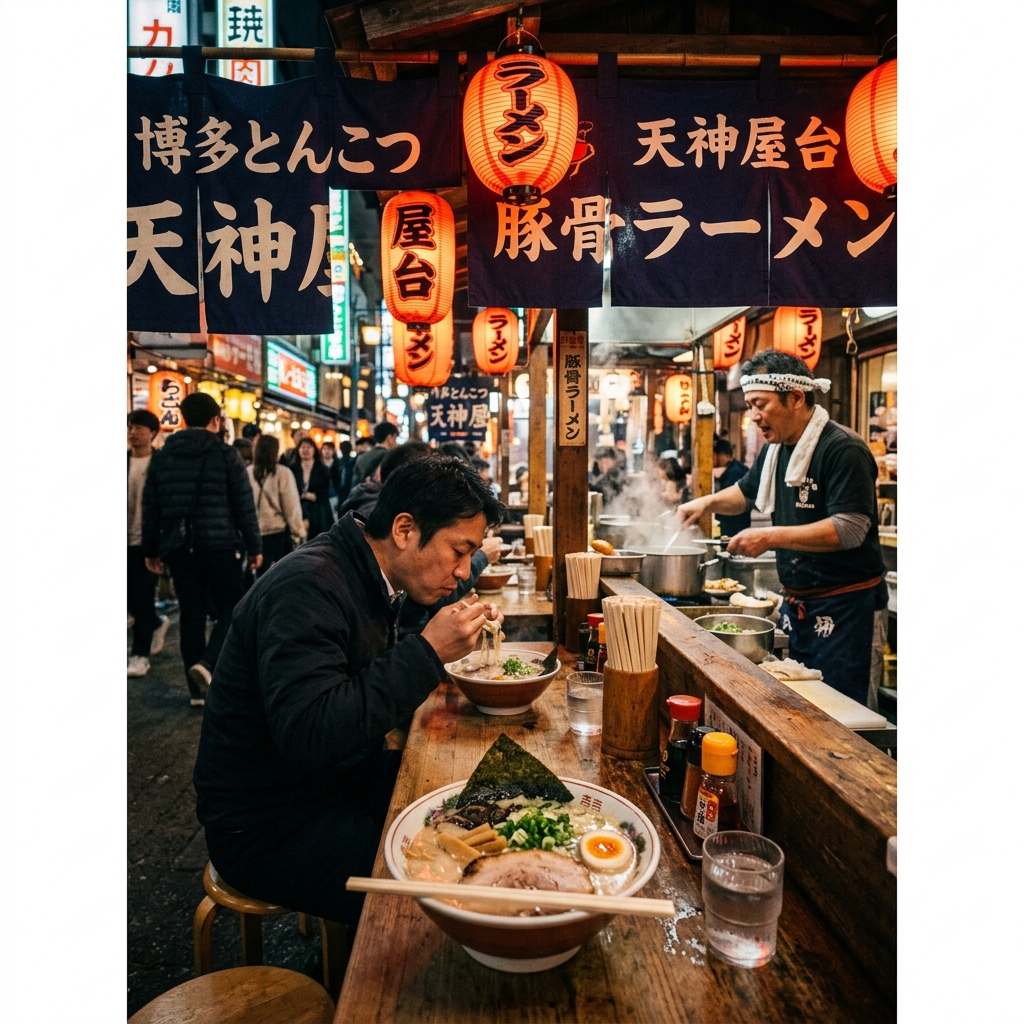
Hakata ramen is Fukuoka's most famous export: thin, straight noodles in a milky-white tonkotsu broth. The broth is lighter than most tourists expect, almost elegant in its porkiness. The ritual of ordering kaedama (替え玉), an extra serving of noodles to add to your remaining broth, is essential. It costs about ¥100 to ¥150 and transforms one bowl into a two-act experience.
But drive forty minutes south to Kurume (久留米), and you'll find the original tonkotsu ramen, the ur-bowl, the source code. Kurume ramen doesn't whisper. It grabs you by the collar. The broth is thicker, richer, more aggressively porky, often simmered in pots that haven't been fully emptied in decades. The shop adds new bones and water to a base that carries the memory of ten thousand previous bowls. It's called yobimodoshi (呼び戻し, "calling back"), and it creates a depth of flavor that you simply cannot replicate from scratch.
Order like a local: When asked about noodle firmness, don't just say katame (硬め, firm). The real spectrum goes: yawame (やわめ, soft) → futsu (普通, normal) → katame (硬め, firm) → barikata (バリカタ, very firm) → harigane (ハリガネ, "wire", meaning barely cooked) → kona otoshi (粉落とし, "dust off the flour", meaning barely cooked). Most locals go barikata. Anything beyond that is performance art.
And then there are the yatai (屋台), Fukuoka's iconic open-air food stalls that line the banks of the Naka River and cluster around Tenjin and Nakasu. Let me be honest: the ramen at yatai is rarely the best in the city. What's irreplaceable is the experience. Squeezing onto a tiny stool, steam rising into the night air, a cold Asahi in hand, elbows brushing with strangers who become conversation partners within minutes. The yatai are Fukuoka's living room, and eating there on a mild evening is one of those memories that stays with you. Budget around ¥1,500 to ¥2,000 for ramen and a couple of drinks.
Oita: Japan's Fried Chicken Capital (大分・日本一の唐揚げ文化)
Every prefecture in Japan claims to do something best. Oita's claim is fried chicken, and unlike most such boasts, this one is backed by overwhelming evidence. The small cities of Nakatsu (中津) and Usa (宇佐) have been locked in a fierce, semi-serious rivalry for decades over who invented karaage as we know it. Drive through either town and you'll pass karaage shops the way you pass convenience stores in Tokyo. They're simply everywhere.
This is not the standard karaage you get at an izakaya in Shibuya. Oita karaage is marinated for hours, sometimes overnight, in a base of soy sauce, garlic, and ginger that penetrates to the bone. The pieces are larger, often bone-in, and fried to an almost impossible crunch that shatters when you bite through to impossibly juicy meat. Many shops sell by weight: ¥500 to ¥700 for a generous bag, eaten straight from the paper, standing in a parking lot, burning your fingers. Peak dining.
But Oita has a second chicken masterwork: tori-ten (とり天). This is chicken done tempura-style, in a light, crispy batter rather than the heavy coating of karaage, served with a distinctive dipping sauce of mustard and ponzu brightened with kabosu citrus. It's lighter, more elegant, and just as addictive. Oita locals get genuinely confused when they learn the rest of Japan doesn't eat tori-ten regularly.
The secret weapon: kabosu (カボス). This small green citrus fruit is to Oita what lemons are to the Mediterranean. It goes on absolutely everything. Grilled fish, sashimi, fried chicken, even in beer. It's rounder and more complex than yuzu, with a gentle acidity that lifts rather than overwhelms. Oita produces 97% of Japan's kabosu, and it's barely known outside Kyushu. Squeeze it on your karaage. Squeeze it on your tori-ten. Squeeze it on your life.
Miyazaki Chicken Nanban: The Original (宮崎チキン南蛮)
Chicken nanban has gone national in Japan. You'll find it on family restaurant menus from Sapporo to Naha. But what's served elsewhere is, to put it diplomatically, a gentle misunderstanding. The real thing was born in Nobeoka (延岡) in the 1960s, and eating it in Miyazaki is a corrective experience, like hearing a song live after only knowing a phone recording.
The genuine article: bone-in or thick-cut chicken breast, coated in flour and egg, deep-fried until golden, then immediately dunked in a sweet vinegar sauce (nanban-su, 南蛮酢) that clings to every crevice. The acidity cuts through the richness. On top: a positively indecent mountain of hand-made tartar sauce, chunky, eggy, tangy, generous in a way that makes the Tokyo versions look stingy.
There are two rival schools, and Miyazaki locals will defend their allegiance to the death. Ogura (おぐら) in Nobeoka serves the tartar-crowned version that most people picture. Naochan (直ちゃん), also in Nobeoka, serves the original style: no tartar, just the vinegar-soaked chicken in its pure, glistening glory. Both are correct. Both are essential. I refuse to take sides publicly.
While you're in Miyazaki, seek out jidori no sumibi-yaki (地鶏の炭火焼き): free-range chicken grilled over binchōtan charcoal until the outside is nearly blackened and the inside remains succulent and dense with flavor. It arrives looking almost primally simple, dark and smoky, served with nothing but coarse salt and maybe a wedge of lemon. The smoke permeates the meat completely. It's the kind of dish that reminds you fire was humanity's first and best cooking technology. You'll find it at izakayas throughout Miyazaki city, often paired with cold shochu and the sound of local baseball on TV.
Nagasaki's Melting Pot: Champon and Sara Udon (長崎ちゃんぽん・皿うどん)
Nagasaki is what happens when you leave one port open for two hundred years while the rest of the country is sealed shut. Chinese traders, Portuguese missionaries and Dutch merchants all came through Nagasaki, and they all left something in the kitchen. The result is a food culture that feels distinctly Japanese and distinctly not, sometimes in the same bite.
Champon (ちゃんぽん) is the crown jewel: thick, chewy noodles cooked directly in a creamy broth of pork bone and chicken stock, piled high with a stir-fried mountain of cabbage, bean sprouts, squid, shrimp, pork belly, and kamaboko fish cake. It's the opposite of minimalist. It's hearty, warming, and filling in a way that makes you want to take a long walk along the harbor afterward. The dish was invented at a Chinese restaurant called Shikairō (四海樓) in the Meiji era, originally as affordable fuel for Chinese students. It remains exactly that: a ¥900 bowl that could power you through an entire afternoon.
Sara udon (皿うどん) takes the same stir-fried topping and places it on a nest of crispy thin noodles that crack and shatter under the weight. The sauce soaks in gradually, creating layers of texture from crunchy to soft as you eat. Drizzle Worcestershire sauce on top. I know it sounds strange, but the tangy sweetness cuts through the richness perfectly.
Halfway trick: Locals add a splash of rice vinegar to their champon about halfway through the bowl. It brightens everything, resets your palate, and effectively gives you a second dish. Try it. You'll never go back.
Before you leave Nagasaki, pick up castella (カステラ), the Portuguese sponge cake (pão de Castela) that arrived in the 16th century and became so thoroughly Japanese that most people here have no idea it's foreign. Fukusaya (福砂屋), founded in 1624, makes what many consider the best version: dense, moist, with a caramelized sugar crust on the bottom. It travels well, which makes it perfect road trip fuel.
Kumamoto: Horse Meat and the Mystery Soup (馬刺し・太平燕)
Let me address the room: yes, Kumamoto is famous for raw horse meat. And yes, you should try it.
Basashi (馬刺し) is horse sashimi: thin slices of deep ruby-red meat, lean and cool, arranged on a plate with surgical precision. It's served with grated ginger, sliced garlic, and a slightly sweet soy sauce that balances the meat's clean, faintly sweet flavor. Kumamoto produces the majority of Japan's horse meat, and the quality here is extraordinary. Marbled cuts called futaego (ふたえご) and tategami (たてがみ, mane) offer textures you won't find in any other type of sashimi. The first-timer hesitation lasts exactly one bite. The second slice, you're already converted.
But Kumamoto's most fascinating dish might be taipien (太平燕). This Chinese-influenced soup features springy glass noodles made from green bean starch, a clear chicken-and-pork broth loaded with vegetables, shrimp, squid, and pork, all crowned with a single fried egg that slowly melts into the soup. It's the kind of dish that sounds unremarkable on paper and becomes revelatory in practice.
Taipien is served in virtually every school cafeteria in Kumamoto Prefecture. Ask any Kumamoto native about it and watch the transformation. Their eyes go soft, they smile involuntarily, and they start talking about their elementary school lunch lady. It's a dish woven into childhood memory, as emotionally loaded as it is delicious. Outside Kumamoto, it barely exists. Inside Kumamoto, it's practically air.
Kagoshima: Black Pork and Polar Bears (黒豚・白くま)
Kagoshima sits at the southern tip of Kyushu, staring across the bay at the perpetually smoking Sakurajima volcano. The volcanic soil, the warm climate, the sweet potato fields stretching to the horizon: everything about this place conspires to produce extraordinary ingredients. Chief among them: kurobuta (黒豚), Berkshire black pork that has been raised here for over four hundred years.
Kurobuta tonkatsu in Kagoshima is a life-altering experience. The cutlet is thick, easily twice what you'd get in Tokyo, fried in a light, delicate panko coating that serves as a frame for the star: meat so juicy and richly flavored that you understand, perhaps for the first time, what pork is actually supposed to taste like. It arrives on a wooden board alongside cabbage shredded so fine it resembles silk thread, a small mountain of rice, and miso soup. It costs around ¥1,500 to ¥1,800, and you'll think about it for weeks.
For dessert (or honestly, as a meal unto itself), find a shirokuma (白くま). Literally "polar bear," this is Kagoshima's iconic shaved ice creation: a towering dome of finely shaved ice drenched in condensed milk, decorated with colorful pieces of fruit, sweet beans, mochi, and sometimes a cherry on top that gives the whole thing its bear-face appearance. The original comes from Mujaki (むじゃき) in the Tenmonkan entertainment district, where they've been building these frozen monuments since the 1940s. In the Kagoshima summer heat, which is considerable, a shirokuma is less a dessert and more a survival mechanism.
The Road Trip Bonus: Michi-no-Eki Discoveries (道の駅グルメ)
Some of the best eating in Kyushu happens in the places you weren't planning to stop. Japan's michi-no-eki (道の駅), the roadside rest stations, are a national institution, but in Kyushu they reach a particular level of excellence. They're also a campervan traveler's best friend: free parking, clean restrooms, local information, and food products that would cost twice as much in a city department store.
- Mentaiko (明太子): Spicy pollock roe, Fukuoka's most famous souvenir. Buy it direct from local producers at michi-no-eki near Fukuoka for a fraction of airport prices. Some stations let you taste before buying.
- Yuzukosho (柚子胡椒): A paste of yuzu citrus zest and green chili peppers, originally from Oita's Hita region. It's one of the most versatile condiments in existence: electric on grilled meat, transformative in soup, revelatory on a simple bowl of rice. Buy several jars. You'll run out.
- Kabosu everything: In Oita's roadside stations, you'll find kabosu juice, kabosu ponzu, kabosu jam, kabosu candy, kabosu ice cream, and kabosu products you didn't know could exist. Embrace it.
- Fresh citrus: Kagoshima's mikan and Kumamoto's dekopon (デコポン), the knobby sweet mandarin with the distinctive bump on top, are best bought roadside, where they're often sold in generous bags for ¥300 to ¥500.
- Shochu (焼酎): Kyushu is shochu country, not sake country. The distinction matters. Sake is brewed from rice in the cold north. Shochu is distilled: from sweet potato (imo-jōchū, 芋焼酎) in Kagoshima, from barley (mugi-jōchū, 麦焼酎) in Oita, from rice in Kumamoto. Many michi-no-eki offer tasting sets. The sweet potato varieties from Kagoshima are earthy, complex, and utterly unlike anything else in the spirits world. Drink it oyuwari (お湯割り, mixed with hot water) on a cool evening, and you'll understand why Kyushu never bothered much with sake.
Campervan tip: Many michi-no-eki in Kyushu allow overnight parking for campervans, though policies vary by station. Look for stations with designated RV park areas. Facilities like Michi-no-Eki Itoda (道の駅 いとだ) in Fukuoka and Michi-no-Eki Taketa (道の駅 たけた) in Oita have excellent setups. Stock up on local food in the afternoon, park up, cook something simple in the van, and open a local shochu as the sun goes down. That's the good life.
The Meal That's Always Next
You could spend a month eating your way through Kyushu and barely scratch the surface. I haven't even touched on Saga's Sicilian rice (a gloriously weird local invention), Fukuoka's motsunabe (もつ鍋, offal hot pot that converts skeptics in one bite), or the jigoku-mushi (地獄蒸し, "hell steaming") cuisine of Beppu, where food is cooked in natural hot spring steam. Every prefecture has its pride. Every small town has its quiet masterpiece. Every roadside stop has something that will make you pull over and think, How did I not know about this?
That's the magic of eating in Kyushu. Forget Michelin stars, Instagram aesthetics and the right omakase counter. What stays with you is a ¥500 bowl of udon that makes you forget language, a piece of fried chicken eaten standing in a parking lot that recalibrates your understanding of what fried chicken can be, a bowl of taipien that makes a grown adult from Kumamoto tear up with nostalgia.
The best meal in Kyushu is always the next one. Get in the van. Start driving south. Stop when something smells good. You won't be disappointed.