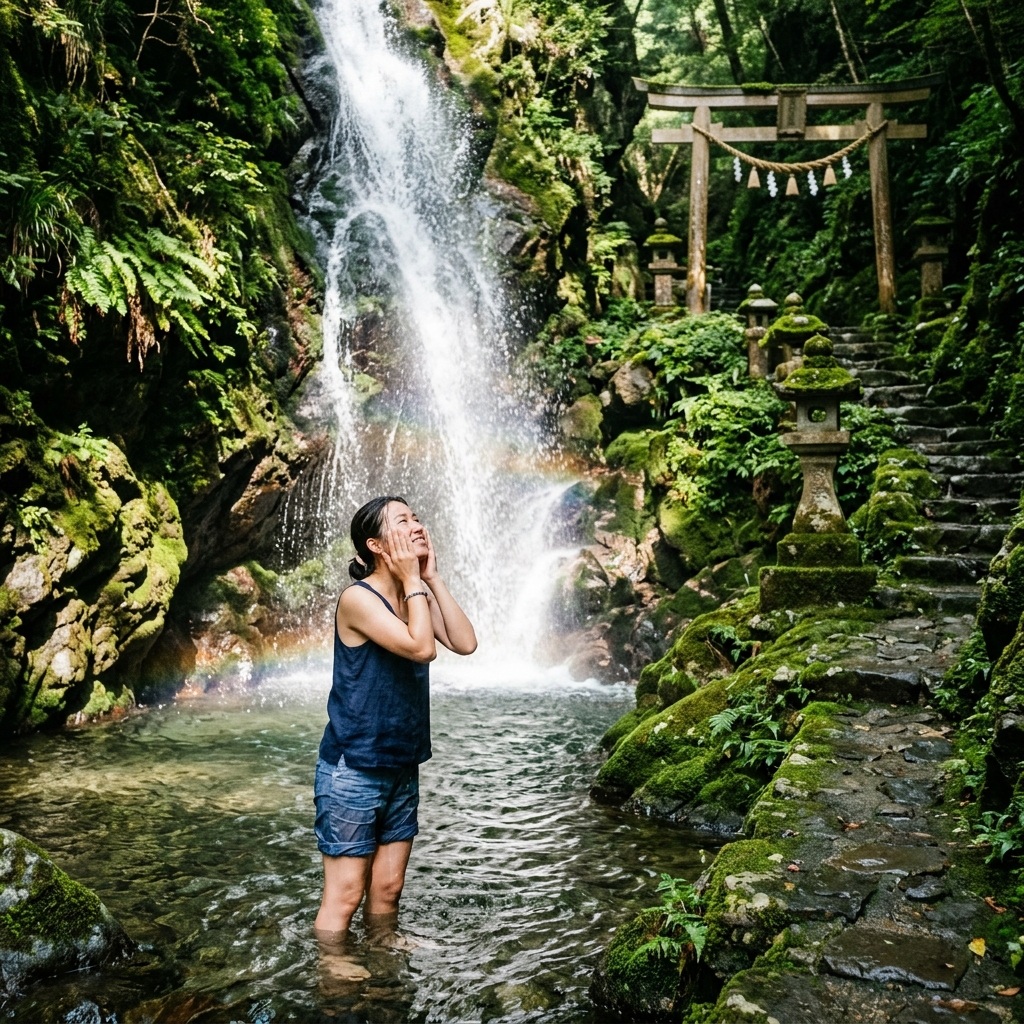
Let's get this out of the way: Kyushu summers are brutal. By mid-July, Fukuoka is regularly hitting 35°C with humidity so thick you could wring the air out like a washcloth. Step outside at noon and the asphalt shimmers. Your shirt is soaked before you reach the konbini. Weather apps flash heat warnings like they're personally offended.
And yet summer is my favorite season here. I realize that sounds slightly unhinged. After 35-odd years of living on this island, I've come to understand something that most visitors miss entirely: Kyushu locals haven't just learned to survive the heat. They've turned it into an art form. The gorges are cooler, the shaved ice is finer, the festivals are wilder, and the onsen (yes, onsen in summer) hit different when you know where to go.
Consider this your insider briefing. Everything your guidebook skipped.
Into the Gorges: Where Summer Drops 10 Degrees
The Japanese have a word for this: suzushii (涼しい). It doesn't just mean "cool." It carries a sense of refreshment, of relief, of almost spiritual reprieve from the heat. And nowhere delivers that feeling quite like the gorges and waterfall pools scattered across Kyushu's volcanic interior.
Kikuchi Gorge (菊池渓谷), Kumamoto
If Kyushu has a natural air conditioner, this is it. Tucked into the northern slopes of the Aso volcanic range, Kikuchi Gorge sits at around 500 meters elevation, and the temperature plummets the moment you step beneath its canopy of ancient broadleaf forest. I'm not exaggerating. Thermometers consistently read 8 to 10°C cooler than Kumamoto city, just an hour's drive away.
The water is absurdly clear. Fed by underground springs filtered through volcanic rock, it runs over mossy boulders in a series of cascading pools that look like they were art-directed by Studio Ghibli. Locals wade right in. This isn't a "look but don't touch" attraction. Bring water shoes and a towel. There are shallow pools perfect for cooling your feet while eating an onigiri, and deeper sections where you can properly swim.
Local tip: Arrive before 8:30 AM on a weekday. By 10 AM on weekends, the parking lot is full and the main trail gets congested. Early morning light filtering through the canopy onto the mist rising from the water is one of the most beautiful things I've seen in decades of living here. The ¥300 maintenance fee is the best deal in Kyushu.
Takachiho Gorge (高千穂峡), Miyazaki
Yes, you've seen the photos. Yes, it's on every "Top 10 Japan" list. And yes, it absolutely deserves to be. But here's what the lists don't tell you: timing is everything at Takachiho, and most visitors get it wrong.
The tour buses roll in around 10 AM and clear out by 3 PM. Show up at 4 PM on a summer afternoon and you'll find the gorge almost to yourself. The late light catches the 17-meter Manai Falls at a gorgeous angle, the basalt columns glow warm, and the rowboat queue, which can stretch to a two-hour wait at peak times, shrinks to 20 minutes or less. The boat rental is ¥5,100 for 30 minutes (up to three people), and it's worth every yen. Paddling between those towering columnar basalt walls, looking up at the waterfall from directly below. There's nothing else like it.
Local tip: After the gorge, drive 10 minutes to Takachiho Shrine and catch the nightly yokagura (夜神楽) performance at 8 PM. It's a condensed version of the sacred Shinto dances performed here for centuries. ¥1,000, and utterly spellbinding.
Todoroki Falls (轟の滝), Kagoshima
This one stays off most tourist radars, and the locals who swim here would like to keep it that way, so I'll be brief. Located in the Kimotsuki area of southern Kagoshima, Todoroki is a 46-meter waterfall that crashes into a wide, deep pool surrounded by lush subtropical forest. The pool is genuinely swimmable, and on a scorching August afternoon, you'll find local families doing exactly that. No ticket booth. No gift shop. Just a short forest trail, a thundering waterfall, and water cold enough to make you gasp.
The drive down through the Osumi Peninsula is half the reward. Winding mountain roads run through cedar forests with almost no traffic. If you're traveling by campervan, there are several quiet spots along the route where you can park up for the night with nothing but cicadas and stars for company.
The Art of Kakigōri (かき氷)
If you think you've had shaved ice, but you haven't had Japanese kakigōri, then, with respect, you haven't had shaved ice. What arrives at your table in a proper kakigōri shop bears roughly the same resemblance to a Western snow cone as a kaiseki course bears to a microwave dinner.
The ice is shaved so fine it's close to frozen air: a towering, cloudlike mound that collapses on your tongue into pure, flavored meltwater. No crunching, no brain freeze (well, maybe a little). The texture is the whole point, and the best shops obsess over it.
Regional Flavors Worth Seeking Out
- Yame matcha (八女抹茶): Yame, in southern Fukuoka Prefecture, produces some of Japan's finest green tea. Kakigōri topped with thick, bittersweet Yame matcha syrup and a drizzle of condensed milk (練乳) is a summer institution. The contrast of bitter and sweet against that ethereal ice texture is genuinely transcendent.
- Amaou strawberry (あまおうイチゴ): Fukuoka's famous Amaou strawberries get turned into intensely flavored syrups during summer. The name stands for amai, marui, ōkii, umai (sweet, round, big, delicious). Look for shops advertising 自家製シロップ (house-made syrup) rather than the neon-colored commercial stuff.
- Miyazaki mango: Miyazaki Prefecture grows mangoes that rival anything from Southeast Asia, and in summer they become the star of local kakigōri. Picture: shaved ice crowned with slices of sunshine-yellow mango, a pour of mango purée, and sometimes a scoop of mango gelato. It's obscene in the best possible way.
Know this: If you see a shop advertising tennen-gōri (天然氷), you've struck gold. That's naturally frozen ice harvested from mountain ponds in winter. Only a handful of ice houses in Japan still produce it, and the difference in texture is immediately obvious. It shaves smoother, melts slower, and somehow tastes cleaner. Expect to pay ¥800 to ¥1,500 for the privilege. Do it anyway.
Summer Onsen: The Counterintuitive Genius
I understand the instinct. It's 34°C outside. The last thing you want to do is sit in hot water. Every cell in your body is screaming for air conditioning and a cold Asahi. But stick with me here, because summer onsen is one of Kyushu's best-kept secrets, and there are good reasons locals keep going year-round.
The Morning Bath (朝風呂)
The trick is timing. Set your alarm for 5:30 AM, before the heat builds, and find an outdoor bath (rotenburo, 露天風呂) with a mountain view. The air is still cool, mist hangs in the valleys, birds are the only sound. You sink into the water, and because the air temperature is comfortable, the hot spring doesn't feel overwhelming. It feels like being held. Your muscles unknot. The day hasn't started yet, and it's already perfect.
Beppu and Yufuin in Oita Prefecture are obvious choices, but for a true asa-buro experience, seek out smaller rural onsen that open at 6 AM. Many charge just ¥200–500 for a morning soak. Ask at any Michi-no-Eki (roadside station) in Oita and the staff will point you to their local favorite.
Sand Baths at Ibusuki (指宿の砂むし温泉)
Now I know what you're thinking. Being buried in naturally heated volcanic sand, on the beach, in summer? In Kyushu? Have the locals lost their minds?
Fair question. The answer: the sand bath experience at Ibusuki lasts only 10 to 15 minutes, and the combination of geothermal heat, the weight of the sand, and the ocean breeze creates a sensation that's genuinely unlike anything else. You sweat intensely, since it works like a natural sauna, and when you emerge and rinse off in the adjacent onsen, the cooling effect is dramatic. Locals swear it clears the skin, relieves fatigue, and resets the body for summer. I tend to agree.
The main facility, Saraku Sand Bath Hall, is open from 8:30 AM and costs around ¥1,200 including yukata rental. Go first thing in the morning when the sand is freshest and the beach is quiet.
Cool Springs: Nagayu Onsen (長湯温泉)
Not all onsen are scalding. Nagayu Onsen, in the rural highlands of Oita Prefecture, features naturally carbonated springs (tansansen, 炭酸泉) that hover around 32 to 38°C, barely above body temperature. Slipping into the fizzing, mineral-rich water on a hot day feels like getting into a giant glass of warm Perrier. Tiny bubbles cling to your skin. It's cooling, restorative, and mildly surreal.
Local tip: The outdoor bath at Lamune Onsen (ラムネ温泉) in Nagayu is one of the most unique bathing experiences in Japan. The name literally means "lemonade hot spring," after the carbonation. The architecture, designed by Terunobu Fujimori, is as eccentric and wonderful as the water itself.
Summer Festivals: When Kyushu Catches Fire
Summer in Japan means matsuri (祭り), and Kyushu does festivals with an intensity that borders on feral. These aren't polite, orderly affairs. They're loud, sweaty, chaotic, beautiful expressions of community spirit that have been running for centuries.
Hakata Gion Yamakasa (博多祇園山笠)
If you are anywhere near Fukuoka between July 1st and 15th, rearrange your plans. Yamakasa is the real thing: a 780-year-old festival where teams of men in fundoshi (loincloths) and happi coats race through the streets of Hakata carrying elaborately decorated floats (kakiyama) weighing over a ton each. Water is hurled over the runners from buckets along the route. The shouting is deafening. The energy is volcanic.
The climax is the Oiyama (追い山) on the morning of July 15th. It starts at 4:59 AM (yes, that's not a typo) and the entire course erupts into controlled chaos as seven teams race a five-kilometer route through the pre-dawn streets. If you want to understand Hakata's soul, this is where you'll find it.
How to experience it: The decorated display floats (kazari-yama) are set up around Hakata from July 1st and are worth seeing even if you miss the running events. For the Oiyama itself, stake out a spot near Kushida Shrine by 4 AM. Yes, it's absurdly early. Bring coffee. You'll forget about sleep the moment it starts.
Fireworks: The Beauty of Small-Town Hanabi (花火大会)
Here's something beautiful about summer in Kyushu: virtually every town, no matter how small, holds its own fireworks festival (hanabi taikai). We're talking about communities of 5,000 people putting on 30-minute shows over rivers and harbors with a sincerity and pride that puts corporate-sponsored mega-events to shame.
The big shows are spectacular: Fukuoka's Ōhori Park fireworks, the Kumamoto fireworks over the Shira River, the massive Beppu display over the bay. But the magic is in the small ones. A fishing port in Amakusa. A riverside park in some Oita mountain town you've never heard of. You park your van, open the side door, pour a cold chu-hai, and watch the sky explode in perfect silence between the booms. These are the moments you came to Japan for.
Check local tourism websites or simply ask at any Michi-no-Eki. They'll have flyers for every hanabi within a 50-kilometer radius. Most run from late July through August.
Wearing Yukata (浴衣)
If there's one summer tradition to embrace, it's this: rent or buy a yukata (a light cotton kimono worn in summer) and wear it to a festival. They're sold everywhere from department stores to ¥3,000 fast-fashion sets that include geta sandals. You will not look silly. You will look like someone who understands that summer in Japan has a dress code, and the dress code is gorgeous.
Van Life in Summer: The Honest Version
I'm going to level with you, because you deserve honesty over marketing: sleeping in a campervan when it's 35°C and 80% humidity at sea level is, let's say, character-building. If your plan is to park at a coastal Michi-no-Eki in Fukuoka in August and get a restful eight hours, you're going to have a rough night.
But Kyushu's geography is your secret weapon, and locals have been using it for centuries.
Head for the Highlands (高原へ)
Kyushu's volcanic spine means that within 60–90 minutes of any sweltering coastal city, you can be at 600–1,000 meters elevation where temperatures drop 5–8°C and breezes actually exist. The difference is transformative.
- Aso Highlands (阿蘇高原): The vast caldera grasslands around Mount Aso sit at roughly 500 to 900 meters. Nights are genuinely comfortable: low 20s, sometimes high teens. Several Michi-no-Eki in the area offer excellent overnight parking with mountain views that make you forget the coast is melting.
- Kuju Plateau (久住高原): Southeast of Aso, the Kuju range offers some of Kyushu's highest driveable terrain. The plateau campgrounds here are popular with locals precisely because sleeping is actually pleasant. Morning mist, cool air, green in every direction.
- Ebino Plateau (えびの高原): In southern Kyushu, between Kumamoto and Miyazaki prefectures, this highland area near Kirishima offers crater lakes, hiking trails, and blessed relief from the Kagoshima heat.
Practical Gear That Actually Helps
- Portable fans + power station: A USB-powered fan running off a portable battery makes a genuine difference in a van. Position it to create cross-ventilation with a cracked window.
- Window mesh screens: Open windows are essential; mosquitoes are not. Magnetic mesh screens that fit over van windows are a ¥2,000 investment you'll be grateful for every night.
- Cooling towels and ice packs: Freeze a water bottle during the day (most konbini will let you use their freezer if you ask nicely). Wrap it in a towel and use it as a pillow cooler. Low-tech. Effective.
- Strategic timing: Drive in the evening when temperatures drop. Find your highland spot. Sleep during the coolest hours (2–6 AM). Rise early, hit a gorge or an asa-buro onsen before the heat returns.
The Reward
Summer sunsets in Kyushu are the longest and most dramatic of the year. Golden hour stretches from around 6:30 PM past 7:30 PM, painting the Aso grasslands in amber, turning the Amakusa Islands into silhouettes, setting the Genkai Sea on fire. You're parked on some highland pullover, the van door is slid open, the air is finally cooling, and the sky is doing things that would make a painter throw away their brushes in defeat.
That's the trade. You deal with the heat, and Kyushu gives you that.
A Few More Things Only Locals Know
- Convenience store hack: Every konbini sells frozen fruit bars, ice-cold mugicha (麦茶, barley tea), and hiyashi (chilled) noodles in summer. A ¥200 lunch of zaru soba from 7-Eleven, eaten in the shade, is a perfectly acceptable summer meal. No shame.
- Department store basements: The underground food floors (depachika) of any department store are aggressively air-conditioned and full of free samples. On the hottest days, locals use them as climate refuges disguised as shopping trips.
- Hydration is not optional: Carry a water bottle everywhere. Vending machines on every corner sell sports drinks and water for ¥100 to ¥160. Heat exhaustion (netchūshō, 熱中症) is taken very seriously here, so don't be tough about it.
- The cicada soundtrack: The roar of semi (蝉, cicadas) is the defining sound of Japanese summer. It's overwhelming at first, genuinely deafening in forested areas, but give it a few days and it becomes the white noise of the season. When they suddenly stop in September, you'll miss them.
Lean Into It
There's a concept in Japanese aesthetics called fūryū (風流), an appreciation for the elegance found in nature and the changing seasons, even the uncomfortable ones. Summer in Kyushu is fūryū at its most intense: the lushness of the green, the thunder of afternoon storms, the sharp cold of a mountain stream against sun-heated skin, the way a single bite of perfect kakigōri can recalibrate your entire afternoon.
Most visitors come to Kyushu in spring for cherry blossoms or autumn for foliage. They're not wrong. Those seasons are beautiful. But they're missing the season that Kyushu does with the most passion, the most flavor, and the most soul.
Summer here isn't something to endure. It's something to lean into, with a cold barley tea in one hand, a festival towel around your neck, and the knowledge that the best waterfall pool, the best kakigōri shop, the best highland sunset is just a short drive away.
The locals have known this for centuries. Now you do too.