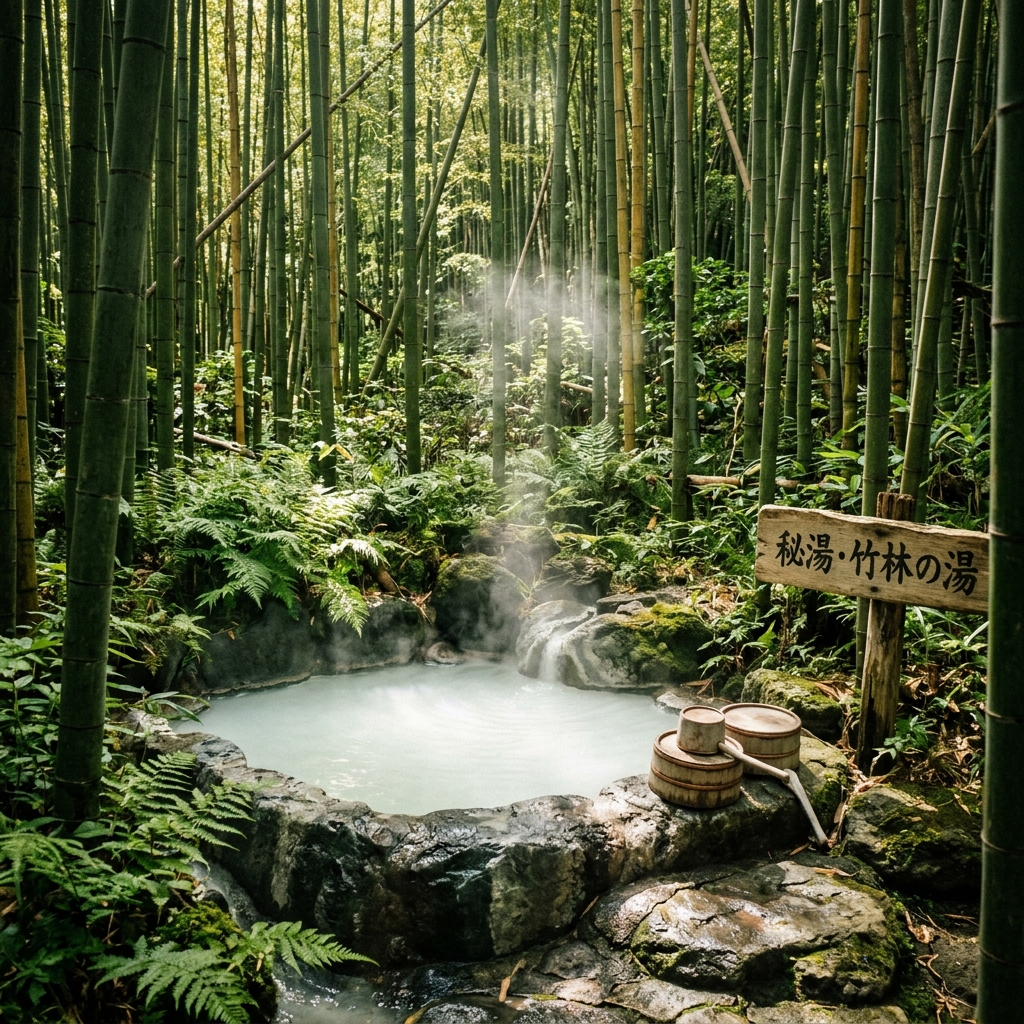
I'm going to tell you about a place that isn't in any guidebook. Not in Lonely Planet, not on most Japanese travel blogs, not even on the radar of onsen-obsessed locals who think they've bathed in every hidden spring Beppu has to offer. I've lived in Kyushu for over three decades, and the first time I visited, I stood at the entrance genuinely unsure if I was in the right place.
Here's the scene: you've just exited the Beppu IC, driven ten minutes uphill into the Myoban (明礬) area. This is the part of Beppu where the air tastes faintly of sulfur and wisps of steam drift across the road like lazy ghosts. You pull into a small gravel lot in front of what is, unmistakably, someone's house. A regular, lived-in Japanese home. An elderly man steps out, smiles, and waves you toward the front door.
You're thinking: Did I type the wrong address?
You didn't. You're exactly where you need to be. And what lies beyond that front door (or rather, three hundred meters down a bamboo-canopied path behind it) is one of the most extraordinary bathing experiences in all of Japan.
Through the Bamboo: Where the Path Takes You
After checking in at the house (yes, the living room is the reception), you're pointed toward a narrow trail that disappears into a dense bamboo grove. The path slopes gently downhill, and the world changes with every step. The traffic noise fades. The air cools. Overhead, bamboo stalks arc together into a cathedral ceiling of green, filtering the sunlight into something dappled and dreamlike.
About halfway down, you catch the first scent: that unmistakable, egg-tinged whisper of sulfur that tells your body hot spring water is near. Then you hear it: the gentle percussion of water trickling over stone. And then, through gaps in the bamboo, you see the first curls of steam rising from somewhere below.
Local tip: The 300-meter walk down is half the magic. Don't rush it. In June, wild hydrangeas (紫陽花) bloom along the path. In autumn, the bamboo frames bursts of red and gold maple. Even in summer, the canopy keeps things cool, a welcome contrast to the hot water waiting below.
By the time you reach the bottom, the modern world feels very far away. And standing there, surrounded by hand-built stone baths set between bamboo trunks and mossy boulders, steam drifting through shafts of forest light, you realize that one person built all of this by hand, a stone at a time.
A Bath for Every Mood
Yuyama no Sato (湯山の里温泉) isn't one bath. It's an entire world of them: multiple open-air pools scattered through the forest floor, each with its own character, its own temperature, its own reason to linger. You wander between them at your own pace, discovering each one like rooms in an enchanted house that has no walls.
Doroyu: The Mud Bath (泥湯)
This is the one that gets people talking. A milky-white pool thick with natural clay from the surrounding earth, the doroyu is gloriously, unapologetically muddy. The water has a silky, almost oily texture, the kind of bath that makes you understand why Japanese women have raved about bijin no yu (美人の湯, "beauty water") for centuries. You sink in, feel the fine mineral sediment between your fingers, and your skin starts to feel like something expensive happened to it.
The water here is fed by two natural sources: a simple hot spring (単純泉) and a simple sulfur spring (単純硫黄泉), both alkaline at pH 8.6 and rich in metasilicic acid (メタケイ酸), a naturally occurring compound prized in Japanese skincare for its ability to boost collagen and leave skin impossibly smooth. This isn't marketing. This is geology doing what a ¥30,000 facial wishes it could.
Seseragi no Yu: The Stream Bath (せせらぎの湯)
Imagine a shallow, warm pool built directly alongside a natural mountain stream. You're soaking in mineral-rich hot spring water while cool, clean stream water babbles past just an arm's length away. The temperature contrast is addictive: warm mineral water relaxing your muscles while the sound of the stream relaxes everything else. Birds call overhead. A breeze moves through the bamboo with a sound like distant applause.
Futari Katari no Ashiyu: The Lovers' Foot Bath (二人語らいの足湯)
Tucked into a quieter corner of the forest, this intimate foot bath is built for two. The name translates to something like "the foot bath where two people talk," and that's exactly what it's for. Sit side by side, dangle your feet in the warm water, and let the conversation go wherever the bamboo takes it. It's modest, it's simple, and it might be the most romantic spot in Beppu that nobody knows about.
The secret within the secret: There are more baths scattered through the grounds than you'd expect. Part of the joy is simply wandering and discovering them: a stone pool here, a wooden soaking tub there. Each one was placed with an intuitive sense of how the landscape wanted to be used. Don't try to see them all in an hour. Give yourself the whole afternoon.
Jigoku-Mushi: Steam Your Own Feast (地獄蒸し)
As if the baths weren't enough, Yuyama no Sato also has a jigoku-mushi (地獄蒸し, "hell steaming") station where you can cook food using natural geothermal steam rising from the earth. Bring eggs, sweet potatoes, vegetables, or whatever you like, and let the earth's own heat do the cooking. There's something primally satisfying about eating a perfectly steamed egg while sitting in a bamboo forest in your swimsuit, your skin still tingling from sulfur water. It's the kind of experience that makes you question every life decision that didn't lead here sooner.
The Man Who Built a Dream with His Own Hands
Every stone bath, every bamboo railing, every hand-carved step on that forest path was built by one man: Tsunematsu-san (恒松さん). And his story is the beating heart of this place.
The site where Yuyama no Sato stands was once known locally as Beppu's "fourth wild onsen" (野湯), one of those unmarked, unmanaged natural hot spring pools that bubble up from the volcanic earth and are used by locals who know where to look. But the surrounding community was aging. Young people had left for the cities. The neighborhood was quietly fading, the way so many rural Japanese communities do.
Tsunematsu-san decided to do something about it. Not with a business plan or investors or a government grant. With his hands. Over roughly a year and a half, with help from friends and family, he transformed the wild onsen site into what you see today: a sprawling network of hand-built baths connected by forest paths, each pool shaped to fit the natural contours of the land, using stone and bamboo and wood sourced from the surrounding mountains.
He didn't build a resort. He built an invitation. Come see this beautiful place. Come feel this water. Come sit in this forest and remember what it feels like to slow down.
A word about wabi-sabi: Nothing here looks "finished" in the way a commercial facility does. Steps are uneven. Bamboo railings are weathered. Some paths are a little muddy after rain. This is entirely the point. In Japanese aesthetics, wabi-sabi (侘寂) finds beauty in imperfection, impermanence, and the handmade. Yuyama no Sato is wabi-sabi given physical form. Soaking in warm mineral water surrounded by it is one of the most authentically Japanese experiences I've ever had.
The contrast is what stays with you. You check in at a completely ordinary house. An elderly man takes your money and points you down a path. And then the forest opens up into this hidden wonderland of steam and stone and warm water. It's like stepping through a wardrobe into a gentler, more magical version of the world. Except the water is real, the minerals are real, and your skin will feel incredible for days afterward.
Why International Couples Are Going to Love This Place
Let's talk about the elephant in the onsen.
For many international visitors, especially couples traveling together, traditional Japanese onsen present a real barrier. The rules are clear and non-negotiable: no swimsuits, complete nudity, genders strictly separated. For Japanese bathers who grew up with this, it's as natural as breathing. For visitors from cultures where communal nudity is, shall we say, less routine, it can be genuinely intimidating. And for couples who traveled to Japan specifically to share experiences together, being separated at the onsen door is a real disappointment.
Yuyama no Sato solves all of this in one stroke.
Every outdoor bath is swimsuit-required (水着着用). Not swimsuit-optional. Required. The baths are mixed-gender (混浴) by design: couples, friends, families, everyone soaks together. You get the full open-air onsen experience (the mineral water, the steam, the forest setting, the deep cultural tradition of Japanese bathing) without any of the anxiety that keeps so many international visitors from ever stepping into a hot spring.
Forgot your swimsuit? No problem. They sell simple, disposable swimwear at the reception desk. No excuses, no barriers.
For those who prefer privacy: Yuyama no Sato also offers three private family baths (家族湯) for ¥1,500 to ¥2,500 per 60-minute session. These are enclosed baths where you can soak however you prefer, swimsuit or not, with just your partner or family. They're a lovely option, though honestly, the magic of this place is in the outdoor forest baths. If you're even slightly comfortable in a swimsuit, go for the rotenburo.
I've brought international friends here (Americans, Australians, Europeans), and the reaction is always the same. First, confused laughter at the house-as-reception. Then wide-eyed wonder on the bamboo path. Then a long, blissful silence as they sink into warm mineral water and realize they're having the authentic Japanese hot spring experience they'd dreamed about, together, without a single moment of discomfort.
What You Need to Know Before You Go
Yuyama no Sato is wonderfully informal, but a few practical details will help you make the most of it.
- Address: 大分県別府市湯山4組 (Yuyama 4-kumi, Beppu, Oita)
- Phone: 090-4988-4179 (call ahead to confirm they're open, since holidays are irregular)
- Hours: 9:00 AM to sunset (reception closes at 17:00)
- Outdoor baths (rotenburo): Adults ¥900 / Children ¥500
- Private family baths: ¥1,500–2,500 per 60 minutes (3 baths available)
- Access: Approximately 10 minutes by car from Beppu IC (別府インター)
- Parking: Space for about 15 cars. Campervans fit comfortably
- Closed: Irregular holidays (不定休). Always call before visiting
⚠️ The outdoor baths literally close at sundown. There is no artificial lighting in the forest. When the sun drops below the ridgeline, the baths close, not because of a rule on a sign, but because you genuinely cannot see. This is the most beautifully impractical operational policy I've ever encountered, and I love it. Aim to arrive by early afternoon so you have time to enjoy everything before the forest reclaims the night.
What to Bring
- Swimsuit: required for the outdoor baths (disposable ones available at reception if you forget)
- Towel: not provided
- Sturdy shoes: the bamboo path is beautiful but can be slippery, especially after rain. Sandals with grip work; smooth-soled flip-flops don't
- Food for jigoku-mushi: eggs and sweet potatoes are classics, but get creative
- Water: you'll be soaking in hot mineral water in a forest; stay hydrated
- A sense of wonder: not optional
The Perfect Beppu Detour: What Else to Do Nearby
Yuyama no Sato sits in the Myoban (明礬) area of Beppu, which I think is the most atmospheric corner of a city that is already dripping with volcanic character. While you're in the neighborhood, a few other stops are essential.
Okamotoya's Jigoku-Mushi Pudding (岡本屋 地獄蒸しプリン)
Five minutes down the road from Yuyama no Sato, the legendary Okamotoya sells what might be the finest pudding in Japan: a firm, caramel-crowned custard steamed over natural hot spring vapor. The texture is denser and more satisfying than conventional purin, with a slight mineral sweetness that you'll spend the rest of your trip trying to find again. You won't. Just go back for seconds. The shop has a terrace overlooking the steaming Myoban landscape, the perfect post-soak reward.
Beppu's Hell Tour (地獄めぐり)
Beppu's famous "hells" (seven spectacularly colored boiling pools ranging from cobalt blue to blood red) are just a short drive away. They're more tourist-oriented than Yuyama no Sato, but they're genuinely impressive natural phenomena and give you the full picture of just how volcanically active this stretch of coastline really is. Pair the hells in the morning with Yuyama no Sato in the afternoon for a day that moves from spectacle to serenity.
Myoban Onsen Area (明礬温泉)
The broader Myoban district is dotted with traditional thatched-roof yunohana goya (湯の花小屋), small huts where mineral bath salts crystallize naturally from rising steam, a practice that's been happening here for centuries. Walking among them, with steam curling from beneath their eaves and the smell of sulfur thick in the air, feels like stepping back a hundred years. Some shops sell the harvested yunohana (湯の花) bath salts. They make a wonderful, lightweight souvenir that lets you bring a little bit of Beppu's mineral magic home.
Van trip route suggestion: Start your morning at the Beppu hells, then drive uphill to Myoban for Okamotoya pudding and a stroll among the yunohana huts. Arrive at Yuyama no Sato by early afternoon and soak until sunset. For overnight stays, Michi-no-Eki Yufuin and other roadside stations (道の駅) in the Beppu-Yufuin area do not prohibit sleeping in the car, which makes this an easy half-day stop on a Kyushu road trip.
Not a Destination. A Discovery.
There are thousands of onsen in Japan. Beppu alone has more natural hot spring sources than almost any city on Earth. You can find marble-floored ryokan baths with ¥50,000 kaiseki dinners, and you can find ¥100 coin-operated neighborhood sentō where the uncle next to you has been soaking in the same spot every evening for forty years. The range is extraordinary.
But I've never been anywhere quite like Yuyama no Sato.
It's not the water, though the water is genuinely excellent: alkaline, silky, and your skin will thank you for days. It's not the setting, though soaking in an open-air stone bath in a bamboo forest while birds sing overhead is about as close to paradise as bathing gets. It's not even the practical genius of the swimsuit policy, though for international couples, that alone makes it worth the visit.
It's the fact that one person looked at an aging community and a forgotten wild spring and said: I can make something beautiful here. And then spent a year and a half doing exactly that, by hand, with local materials, asking nothing more than ¥900 for the privilege of experiencing it.
Yuyama no Sato won't be in your guidebook. Your hotel concierge probably hasn't heard of it. The path is unmarked and the entrance looks like someone's grandmother's house because it is someone's grandmother's house. And that's precisely what makes it perfect.
Some of the best things in Japan aren't destinations. They're discoveries: small, handmade, imperfect, and made with so much care that they change the way you see everything else. Yuyama no Sato is one of those things. And now, you know where to find it.
Wear good shoes. Bring a towel. Follow the bamboo path down. And let an old man's dream show you what a hot spring can be.
Frequently asked questions
What is Yuyama no Sato?
It is a small, hand-built hot spring in the Yuyama area of Beppu, reached by walking down a path through a bamboo grove. One man built the baths, the mud pool and the steam pits himself over about a year and a half. Reception is the owners' living room.
Do I need a swimsuit, and is it mixed gender?
Yes. The outdoor baths are mixed gender and a swimsuit is required, which is what makes this place work for couples and friends travelling together. Disposable swimsuits are available at reception if you forget one. Towels are not provided, so bring your own.
What time does Yuyama no Sato close?
It opens at 9:00 and closes at sunset, with reception closing around 17:00. There is no artificial lighting in the forest, so the baths genuinely close when the light goes. Arrive by early afternoon to enjoy it without rushing.
How much does it cost?
The outdoor baths are 900 yen for adults and 500 yen for children. There are three private family baths at 1,500 to 2,500 yen for 60 minutes. These prices match Beppu's own onsen listings as of 2026. The holidays are irregular, so it is still worth calling 090-4988-4179 before you drive out.
How do I get there, and can I park a campervan?
The drive from Beppu IC takes about 10 minutes. There is space for roughly 15 cars and a campervan fits comfortably. The entrance looks like a private house, because it is one, so watch your navigation carefully on the final approach.
Is it open every day?
No. The holidays are irregular, so always call before you drive out. A short phone call saves a wasted detour.
Getting to Yuyama no Sato
Beppu is an easy drive from Fukuoka, and a campervan means you can soak until the light fades without watching the clock for a train home. See our 3-day Fukuoka to Beppu itinerary, or check which van is free for your dates.