Japanese domestic tourism in Kyushu has a well-worn route: fly into Fukuoka, eat ramen, ride the shinkansen to Nagasaki or Beppu, check into a ryokan, repeat. It's a good route. But it's not the only one.
When we look at the research lists, Google Maps saves, and itinerary questions from our international guests, a completely different Kyushu emerges — one built around geological extremes, mythological landscapes, and experiences that simply don't exist anywhere else in the world. These are the places that consistently surprise and move visitors who've traveled widely but have never encountered anything quite like this.
1. Irome Kumano Shrine (色見熊野座神社) — The Shrine Path No One Told You About
Located in Minamiaso, about 30 minutes south of the Aso crater, Irome Kumano Shrine is approached through a long corridor of moss-covered stone torii gates set among ancient cedars. In morning mist, the path looks like a scene from a Miyazaki film — not because anyone designed it that way, but because the combination of volcanic soil, humidity, and centuries of undisturbed growth has made it that way naturally.
Japanese tourists visit Fushimi Inari in Kyoto for a similar torii experience, but the crowds and commercialization there are significant. Irome is quiet. You'll often have it to yourself on weekday mornings. There's no ticket booth, no souvenir stall at the entrance, no guided tour. Just the path.
Getting there: The shrine sits on a small road off Route 325, about 4km south of Minamiaso Station. No public transport. A van is ideal.
2. Shinmeikan's Cave Bath (新明館 洞窟風呂) — Onsen as Geology
Shinmeikan is a small inn in the Kuma River gorge in Hitoyoshi. The inn's founder spent 3 years in the 1960s hand-digging a cave bath from the riverbank — a 31-meter tunnel through rock that opens into a natural chamber with a spring-fed pool inside. The water temperature is roughly 42°C. The cave itself is dark, warm, and silent except for the sound of dripping water.
Day-use bathing is available by reservation. It has no steam jets, no TV screens, no fancy lighting. It's just a hole in the earth with hot water in it, and it's one of the most memorable onsen experiences in Japan.
Japanese onsen culture often gravitates toward ryokan amenity packages — multiple meals, room service, and a well-maintained bath garden. Shinmeikan is the opposite: austere, geological, completely without performance. International travelers who have read about it in van life communities tend to rate it among their top Japan experiences.
Practical note: Day-use requires a phone reservation. The approach involves crossing the river on stepping stones. Not suitable during heavy rain or flooding.
3. Umakase Lookout (馬ヶ背展望所) — The Cliff the Tourism Brochures Missed
Near Hyuga City on the Miyazaki coast, Umakase is a narrow sea cliff dropping roughly 70 meters straight into the Pacific. The rock formations — columnar basalt pressed into near-vertical walls — are the result of the same volcanic activity that built the entire Kyushu coastline. You walk out along a narrow promontory and look straight down into churning water.
Miyazaki tourism focuses heavily on Udo Jingu shrine and the Nichinan Coast. Umakase is a 15-minute drive north of Hyuga and appears in almost no Japanese domestic travel content, despite being genuinely spectacular. International travelers who include Miyazaki in their van routes discover it and talk about it at length.
4. Takachiho (高千穂町) — Where Japan's Mythology Begins
Takachiho is the place where Ninigi-no-Mikoto, grandson of the sun goddess Amaterasu, descended from the heavens to rule Japan — or so says the Kojiki, Japan's oldest written record. The town takes this seriously. The gorge, the shrines, and the surrounding peaks are all named for figures in the creation myth.
Japanese tourists do visit Takachiho — it's not unknown domestically — but it's still far less visited than it deserves to be relative to its cultural and scenic significance. For international travelers, especially those interested in religious or mythological landscapes (Angkor Wat, Petra, the Western Wall), Takachiho offers something comparable: a place where the landscape and the story are inseparable.
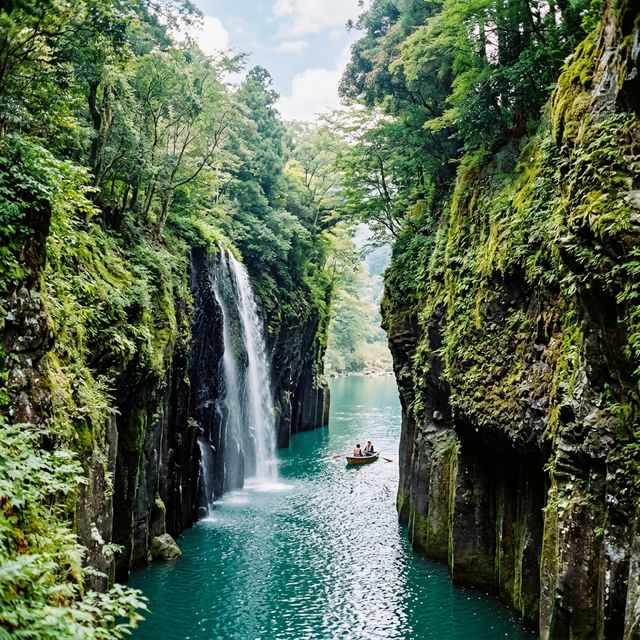
Takachiho Gorge is most visited in the morning, when you can rent a rowboat and float under Manai Falls. The gorge walls rise 80–100 meters above the water. Kagura ritual dances are performed nightly at Takachiho Shrine — a tradition unbroken for centuries.
5. Nichinan Coast & Devil's Washboard (鬼の洗濯板) — Geological Theater
The coast south of Nichinan City has been shaped by millions of years of differential erosion — softer volcanic tuff washed away faster than the harder sandstone, leaving a stepped, ribbed rock platform extending several hundred meters into the sea. Japanese mythology calls them 鬼の洗濯板 — the Devil's Washboard.
At low tide, the platforms are fully exposed and you can walk across them. At high tide, waves break across the ridges. Both states are photogenic in completely different ways. The Michi-no-Eki Phoenix (道の駅フェニックス) sits just above the coast with a viewing terrace and good local food — a natural van stop.
6. Me no Yu (目の湯) — Kirishima's Oldest Rock Bath
In the Kirishima volcanic highlands, Me no Yu is widely described as the oldest outdoor rock bath in the region — a naturally formed stone pool fed by a geothermal spring, with no constructed tiling or modification beyond what was necessary to make it usable. The name means "eye bath," referencing old beliefs about the water's healing properties.
Kirishima is better known internationally for its hiking (Mt. Karakunidake, the highest peak in the range) than its onsen. Me no Yu tends to be found by people who research deeply — which is exactly the profile of international travelers doing pre-trip research into van travel in Japan.
7. Nanatsugama (七ツ釜園地) — Sea Caves on the Saga Coast
On the western coast of Kyushu in Saga Prefecture, Nanatsugama is a cluster of seven sea caves carved into basalt columns by wave erosion. The caves can be viewed from the cliff above or by tour boat from below. The basalt column formations here are similar to those found at Fingal's Cave in Scotland or the Giant's Causeway in Northern Ireland — natural wonders that most visitors from Europe or the Americas recognize immediately as extraordinary.
Saga Prefecture receives a fraction of Kyushu's international tourism despite containing several genuinely world-class natural sites. For campervan travelers, it sits conveniently between Fukuoka and Nagasaki.
Why These Spots Work Better by Campervan
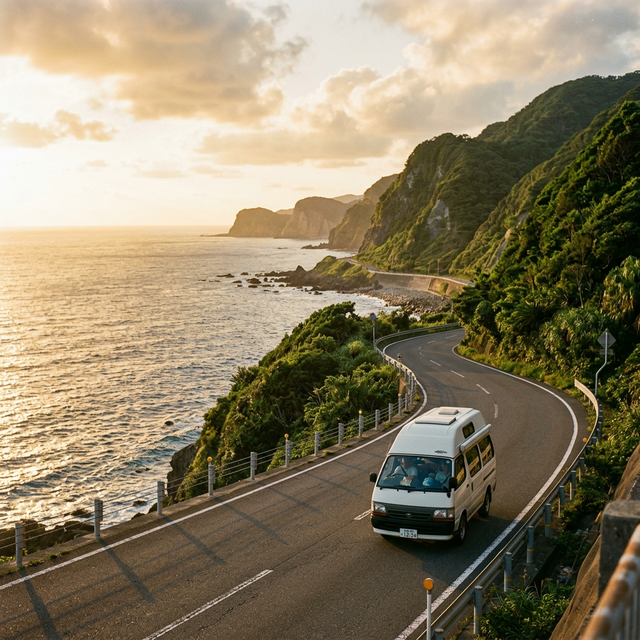
Every location on this list shares one characteristic: no practical public transport access. Irome Kumano Shrine, Shinmeikan, Umakase, the Nichinan Coast, and Me no Yu are all on roads that buses don't serve adequately. The campervan isn't just convenient for these spots — it's often the only realistic way to reach them without a taxi budget that would dwarf the rental cost.
Frequently Asked Questions
What are the most underrated places in Kyushu for international travelers?
The consistently underrated spots are Irome Kumano Shrine (Minamiaso), Shinmeikan cave bath (Hitoyoshi), Umakase Lookout (Hyuga/Miyazaki), the Nanatsugama sea caves (Saga), and Me no Yu (Kirishima). All offer genuinely rare experiences — geological, mythological, or cultural — that have no equivalent in most travelers' home countries. All are best reached by van.
What is Takachiho and why do international travelers love it?
Takachiho is a mountain town in Miyazaki said to be where Japan's creator gods descended to earth according to the Kojiki myth. It's home to a dramatic river gorge with rowboats, nightly kagura ritual dances, and the peak (Takachiho-no-mine) where the divine descent is said to have occurred. For travelers who gravitate toward places where landscape and mythology are fused — Delphi, Uluru, Jerusalem — Takachiho offers something with comparable depth.
How do I fit these spots into a Kyushu van trip?
These locations span Kyushu from north (Saga/Nanatsugama) to south (Nichinan Coast/Miyazaki), so they work best as part of a loop rather than a single corridor. A 7–10 day route starting and ending in Fukuoka can cover all of them while including Aso, Kirishima, and the Nagasaki peninsula. See our 7-Day Kyushu itinerary as a starting framework and add these as targeted extensions.